Tuesday, March 29, 2016

Running For, Powered By...

We closed out last week with our longest training run, and last long-run before Marathon Monday - capping my longest training week at just north of 51 miles.  Tired. But feeling good.Excitement and anticipation mounting.  

Early Saturday morning, the Dream Big! team and hundreds of other charity runners piled into busses and made our way to Hopkinton, to the actual start of the race course. Then we ran the first 21, all the way to the top of Heartbreak Hill.  Only 20 days and another 5.2 to the finish line on Boylston Street.

Now into the blessed tapering phase. Soon we'll all be obsessively checking race-day weather reports.

Stay tuned for more details on how and where to watch and/or track me and others online, on the course, and via text.

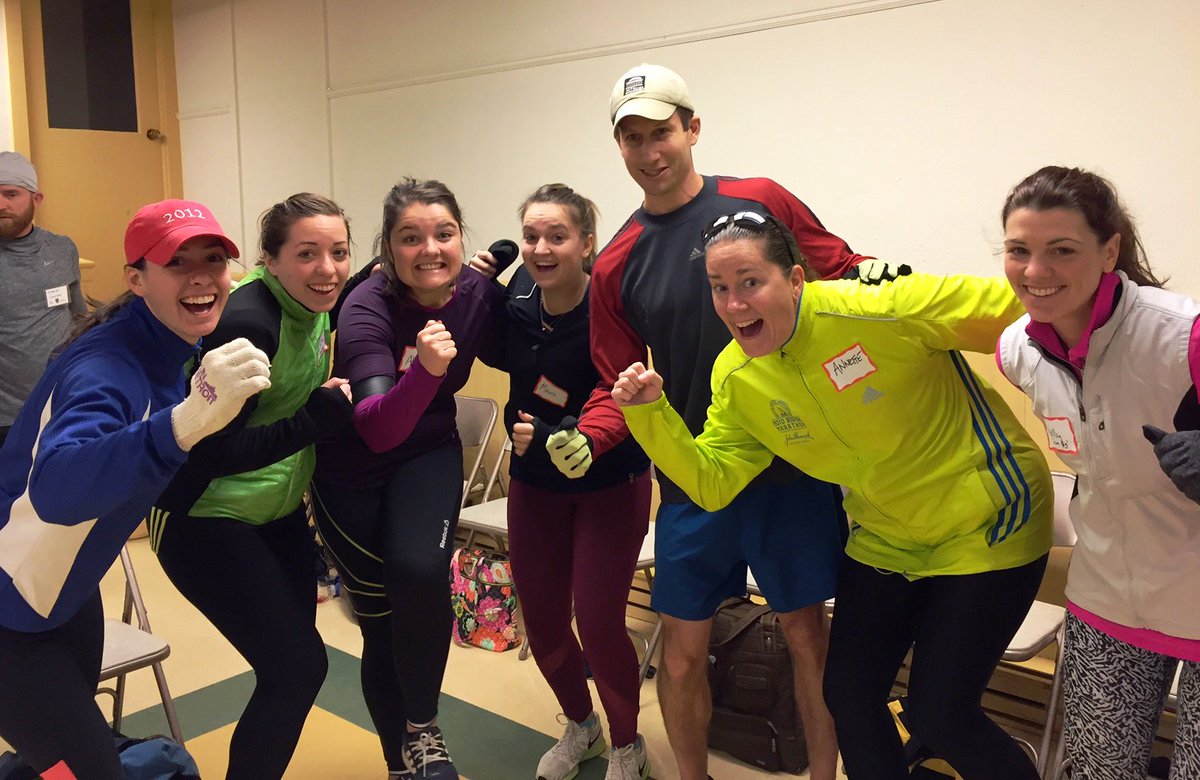
Here are a few of us mugging for the camera in our new Dream Big! race shirts at the starting line...


And here, as promised, the back of my race shirt, now emblazoned with the names of all the girls and women in whose honor folks have contributed to this collective effort for girls' sports - and the brothers and dads and sons who are also champions of the cause, and whose gifts and spirit are powering my run.  With thanks to each and every one of you...


Thursday, March 24, 2016

Enough from Me. Take it from Them.

But enough from me about the power of girls' sports.

Take it from the Lady Tigers - a girls softball team in New York that Dream Big! has supported with donations of everything from softball bats, gloves and helmets, to batting cages and hitting machines.  But more than the chance to play, on the Lady Tigers, these girls find...

"My teammates our my sisters. My coach is my father."


Thank you for considering a gift for Dream Big! to advance their mission of empowering girls through sports.

Monday, March 14, 2016

10 Steps to Meeting That Marathon Charity Fundraising Goal

With only a few weeks until Marathon Monday, this is the #HeartBreakHill moment for many charity runners in their fundraising efforts. Time to find that second, or third, or fourth wind, to try something new, and to keep going.

Here are some ideas.

Having run a few marathons before, when I signed on to run and raise this year for Dream Big! and their mission of empowering girls through sports, I was far more intimidated by the prospect of the fundraising than by all the training miles ahead of me in the dark and cold of a Boston winter. I fully expected that goal to loom over me right until race day, and that making it across the finish line would include my credit card being charged to fill the gap between my goal and wherever I was at that point.

To my surprise, however, I ended up meeting my goal months ago. As I wrote in an earlier post here, I think my first fundraising mistake was to calibrate a goal based on what I thought I was capable of in terms of outreach and asking, rather than on the incredible generosity of friends, family, and colleagues that would be unleashed by the opportunity to advance the mission of this small nonprofit doing big things for girls, and to support me in my efforts on their behalf.

So, to the extent it's helpful for others still on the upward climb this year (and to help me remember if ever I take on the challenge again), here is everything I've done thus far. This is by no means a comprehensive list of all the tools in a fundraiser's toolkit. It's just what one novice tried one year. So, please feel free to suggest other strategies via the comments section below.  

And if you're a believer in the power of sports to impact girls, and reading this prompts a spirit of generosity in you, please consider a gift to encourage one of my Dream Big! team members still on the uphill slog towards their goal.
  1. Give first. My first fundraising act was to make a gift myself. I didn't want to ask others to follow where I wasn't willing to lead.
  2. Be social. After I set up my fundraising page, and made a gift myself, I Tweeted a link to it. And almost right away I got a donation from two folks in my network. Over time, these gifts proved more the exception than the rule. Most of my contributions were prompted by other means. Though social provides a great way to keep steady drumbeat about your efforts. I included a note about my fundraising efforts and link to my donor page on my Twitter profile (and would have used Facebook too, if I were on it.)
  3. Blog. I created this blog as another tool to share about my fundraising and training effort, and for deeper reflections inspired by the mission of the organization I'm raising for. I started posting weekly, and always Tweeted out new entries - tagging Dream Big!, our coach, and/or others who inspired each post.
  4. Make it about we, not me. Two of my colleagues are also running and raising this year for another charity. We organized a single email appeal to all of our colleagues at once.  I think this may have contributed to a sense that folks had a chance to support "our runners," "our team," not just me. Following the "give first" mantra, we each contributed to each other's efforts before sending the blast appeal. Most of the many who gave did so to all three of us.
  5. Blast it (but don't just blast it). Other than that one group email, the only other blast email I sent to a large group all at once was via a Google Group I am on with 40 or so runners I train with in my neighborhood. As with social, while there were a few gifts prompted by those blasts alone, and while I think they are important as awareness builders, they shouldn't be counted on alone. In most cases, an actual gift followed a face-to-face conversation, or at the least a personal email (where they say, "Oh, yeah. I remember seeing something about that. Could you send it again?)
  6. Make it personal. Given the cause I am running and raising for - empowering girls through sports - I knew that the mission was one that would resonate personally with many of my potential contributors, the same way it does for me as a dad of a powerful, sports-loving daughter. So, much of my personal outreach was directly to parents of girls. I also started offering up space on the back of my race shirt, which I am going to cover with the names of all of my contributors, and the girl and women athletes in whose honor they gave.
  7. Put it in your email signature. I added a sentence to my personal email signature about the fact I was running and raising and why, and included links to my donor page and to this blog. This led to at least one unsolicited - though mostly, I think, is useful in the category of keeping up that steady drumbeat - and possibly of helping someone follow through on an intention prompted by some other means you've already used.
  8. Leverage events. Some terrific friends of our were generous enough to host a party in their home to help me and another Dream Big! teammate in our fundraising efforts. Before the Evite went out, I sent individual emails to the 75+ folks on my list. Some came. But even more gave, prompted by that invitation.
  9. Tell everyone. When folks say, "What's new?" tell them you're running and raising. Several folks - especially those who've ever raised themselves before - beat me to the ask when I did. "Be sure to hit me up," they'd say, knowing how hard it can be.
  10. Say (and show) thanks. Possibly more important than any form of ask is what you do after the gift. I acknowledged most gifts by email. But I thanked all with a hand-written note. If it's worth your time to give, it's worth mine to take the time to say thank you. At an early point in our fundraising, I won a friendly competition among my Dream Big! teammates, and a gift card to the Adidas RunBase Marathon Museum and Store. I thought about buying myself some new gear for the big run, or using that card as enticement for more new donors.  I decided instead to raffle it off among those who'd helped me to that point. Glad I did.
Good luck all you charity fundraisers. You can do it!

Wednesday, January 20, 2016

Great Expectations

My mistake, I think, was setting a fundraising goal based on my best guess at what I could do in terms of outreach, creative awareness building, and asking for support.

I should have set a goal based on my best guess at the generosity that would be unleashed from friends, family, and colleagues for the cause of empowering girls through sports.

I never imagined I'd be here this early, but thanks to the overwhelming generosity of nearly everyone I asked - and some who just found out and contributed even before I asked, I hit my fundraising goal over this past weekend - three months ahead of race day.

Somewhere out there is a young woman very much like you, your daughter, your niece. But times are tight for her family. A lost job, scaled back hours, and they've dropped decidedly into low-income status. They may even face homelessness for a time.

She'd love to be active, to play sports and engage in physical activities with her friends. And her family would love for her to. Lately, however, they could only say, "We're so sorry, honey. Maybe next year."

But now, they're saying, "Go for it!" as Dream Big! is turning the $7,000 I pledged and have raised thus far into 150 pairs of new running shoes; or 70x tuition for an 8-week dance or other class; or 35 brand new bikes and helmets; or 14 registrations in a week-long summer sports camp; or uniforms, equipment, and coaching for 7 whole sports teams.

That's a lot of good.

Now, let's do more.

The only time I ever beat a marathon running goal was my very first effort. Crossing the finish line in a respectable time, but with gas still left in the tanks, I realized I had set my goal too slow - and I have failed to reach my goals ever since. I take that as indication of sufficiently aggressive goals; and also of flawed execution.  Yet  with smarter training, some terrific coaching via the Marathon Coalition, and a smarter race day plan, my confidence is growing on the execution piece of beating my running goal.

In the meantime, let's bury my initial fundraising goal, and over-deliver for Dream Big! and girls sports.

A Dream Big!-outfitted softball team

Wednesday, January 6, 2016

Run your own race

In my last post, "The Power of the 'Near Win'," I focused on the motivating power of competition, and especially of the second place finish. In contrast, today's reflection is on the importance - for marathon running, for career, for creative pursuits, for life - of tuning out how anyone else is doing, and running your own race.

There is a 1993 New Yorker cartoon (you can see it, and buy your framed copy here) that has always stuck with me on this point. A man is reading a newspaper and we are looking over his shoulder. We can make out that it is the Obituary section. And though we can't read the text of any of the entries, the headlines all stand out. They read, "Two years younger than you," "Twelve years older than you," "Exactly your age," etc.  Seeing this, I right away thought about it in terms of achievements - how easy it is to read of others' professional, personal, creative, athletic or other accomplishments and to wallow in a sense of envy, inferiority, or - sometimes, if we are CRUSHING IT! in some field of endeavor - to feel smugly gratified by how we are doing in comparison to peers - when the only comparison that matters is between what you are doing and what you're capable of, and how you respond when you run up to your literal or figurative Heartbreak Hill and every fiber of your being and the inner voices begin to say, "Go ahead. Ease up. Walk a bit. No one will know. You'll still finish faster than so many people."

What do you do then?

In one of my opening post on this blog, I wrote about my earlier marathon running efforts, and my repeated failures to achieve a Boston Marathon qualifying time.  I was so fixated on the aggressive and specific pace fast runners were supposed to be able to achieve. And indeed I find, in this round of training again, I am eyeing my new, slower (because I'm older) though still fast qualifying time.

So, it was a counter-intuitive bit of counsel from our coach, Rick Muhr, to forgo any kind of running watch on race day.  The important thing, he counseled, is to listen to your body, to run the smartest and best race you can on race day. Not to chase others, or give in to the anxiety of trying to grab and hold on a pace you have in mind to keep. That is the only way to run your best race. To access that inner calm, strength, and power that is only diffused when our attention is focused on technology strapped to our wrists, or others we are passing or passed by in the midst of a run.

Easier said than done, but that is my aspiration. Only yesterday morning, on my way home from an early training run, I cut through the Arnold Arboretum, and on a trail through the woods suddenly heard the steps of someone running up behind me, catching me, and passing me. Instinctively, even though I was in the wind-down phase of my run, I felt myself winding up, speeding up, and then feeling a bit demoralized as he passed anyway (without even a "Good morning!"). But as I settled back into my own rhythm and pace, by the time I returned home, I had really let him go.

Following the 2013 bombings at the Boston Marathon, while we still follow and cheer the elite runners, a whole new set of runners surged to the forefront of our attentions - those survivors who, running their own race like no other, fought their way back to the finish line.

Here is just one example caught on video:

Tuesday, December 15, 2015

The Power of the "Near Win"

Nothing gets the competitive juices flowing quite like a second-place finish. That was one of my chief takeaways from reading The Rise by Sarah Lewis - a fascinating exploration of how so many of the world's greatest achievements are rooted in failure. The bronze medalist is just happy to have made the podium. The silver medalist, however, seethes with restless dissatisfaction for nearly winning, which often turns into unstoppable motivation to do more, to do better, to win. One of the prime examples of this dynamic was Jackie Joyner-Kersee, who in the 1984 Olympics in LA won the silver medal, losing out by just five points to Australian Glynis Nunn. Four years later, in Seoul, South Korea, Joyner-Kersee won gold in the same event, setting a world record (7,291 points) that still stands today. She also won gold, and set an Olympic record in the long jump (7.4 m). She was later voted by Sports Illustrated as the Greatest Female Athlete of the 20th Century. Here's a recap video of her in Seoul:


The other story that really stuck with me was of 23 year old Julie Moss in the 1982 Iron Man Triathlon. A total unknown, she came out of nowhere, surprising everyone - including herself - by being far ahead and on track for a win by the marathon portion of the race. But then, her stride started changing, something was wrong, and she collapsed to the road, in total exhaustion. She waved off spectators, who came to her to help her stand (it would have disqualified her if she let them). She tried standing a few times, and fell each time. Finally, she started crawling, hand over hand towards the finish. In the dark of that evening, with the TV screen trained on her, making her slow way forward, you can see the feet of the second-place runner overtaking her only a few yards from the finish line. An unbelievable picture of grit and determination. Millions tuned in to that race. And Moss is credited with being the catalyst for the explosive growth in her sport, especially, but not only, among women inspired by her example.

Here's her race:


In a small way, I had my own near win experience on my long training run this past weekend. In preparation for running Boston, I splurged on a GPS watch, and have enjoyed loading and tracking and studying my data on Strava - one feature of which is that it compares your performance not only to yourself (and I will have some future post on the Marathon Zen wisdom of "run your own race" - not here), but with others on various segments of your runs. A few months ago, after a run through the Stony Brook Reservation, in Boston's Hyde Park neighborhood, I came home to discover I'd run the 2nd fastest time on a 3/4 mile climb through the woods. It's been goading me ever since.  I tried again and closed the gap just before Thanksgiving - but still came in second. This weekend, I ran the segment twice. And beat the record the record twice. And got my first little Strava crown icon.


A little silly I know. But it called to mind again The Rise, and these amazing stories.

Somewhere out there is a girl who has never yet tapped the power within her of that "near win." The equipment and coaching fees that you and I would never hesitate to pay for our girls are simply too much for her parents to absorb. Times are just too tight.

This Holiday Season, would you give to Dream Big! so she can play?

Monday, December 7, 2015

Running "Like an Old Lady on a Frozen Lake"

The marathon - especially Boston - is so riddled with meaning and metaphors. The most prominent of which is probably, "Life's a marathon, not a sprint."

I got a new one on Saturday, at the first charity team group training run of the season. Here I am with the others running for Dream Big! because we believe in the power of girls' sports.


Before our run, we heard from coach Rick Muhr, with words of encouragement and counsel - mental, physical, and a little metaphysical.  One thought, and new metaphor, that stuck with me, was on the importance of running NOT like a long-legged gazelle with great leaping strides, but "like an old lady on a frozen lake," with a measured, quiet, shuffling stride that, however counter-intuitive, turns out to be the most efficient way to propel oneself for 26.2.

It's all about efficiency, Rick told us. And though it seems like the way to go faster and further is with a great, reaching stride, the name of the game for marathon success is efficiency - i.e., no wasted effort. And with that long, leaping stride sets one up for striking first with one's heel, and actually throwing the breaks on with each step, even as you are propelling yourself forward. It's also a greater muscle strain for each stride. More difficult to sustain. Heart rate too high. Cadence too low. Each step too loud, too much effort, and leaving one more susceptible to injury. 

The goal, said Rick, is to be at a cadence of 180 strides per minute, three per second. Quiet. Efficient. Heart rate relaxed. Unhurried. Conservative. Like you're driving with the low-fuel light on even when your tank is full. No wasted effort. And then, the metaphor I carried with me for our first training run along the race course (until just shy of Heartbreak Hill) - to run like an old lady on a frozen lake.

There is power and potential in what we might, at first blush, or based on flawed stereotypes or cultural norms, dismiss as weakness. Which reminded me of the #LikeAGirl campaign unleashed at last year's Super Bowl.


A great inspiration and reaffirmation of the importance of Dream Big!'s work, empowering girls through sports.